Wednesday, October 3, 2012

Writer's Workshop: editing

Today we talked about the 4th step in the writing process: editing. I introduced the class to our writer's eyeglasses bulletin board first thing. The students are being taught to use their "writer's eyeglasses" to look at their work a little more closely and fix some of the errors they might have made the first time.


I made these bookmarks to help students remember what information to look for during editing. We will add more to this as the year goes on, but for now I am mostly looking for editing of periods, capital letters, good spaces, and sentences that make sense and are in order.


During editing, students are allowed to use a red pencil to show what changes they made. We have practiced using some basic editing marks so we reviewed those by looking at an example page I wrote together. We went through the writer's eyes checklist one by one and fixed up each thing on the list.


After the students have attemped to edit their work on their own they sign up for a writing conference. To do this they simply move the clip with their number on it from the "I'm working hard on my own" sign to the "I need a writing conference" sign. I can then go down the ribbon and work with each student one on one to help them fix up their work to get it ready for publishing. This is a great opportunity for me to talk to each student one on one about their writing and their thought process.


Next up: publishing!

Tuesday, October 2, 2012

Writer's Workshop: Revision

Today in writer's workshop we started looking at what it means to revise our first draft. We read the book Hello Ocean, which is a great story that uses the five senses to describe a trip to the beach.  We talked about the ways in which the author added detail to help keep the reader interested in their work.


In writer's workshop in our classroom, during the revision stage, students get to use special blue pens. This makes revising and adding details exciting to them, but it also helps me as the teacher to see what their thought process was. Using a different color makes it clear to me what they wrote as a first draft, then how they changed their thinking and added details. We talked about different ways to revise, and I showed the class how to use an asterisk to insert information that might not fit in the space they have left.  Below is a great example of a revision to the first page of a book:


We still need to work on getting that asterisk in the right spot, but the thought is definitely there! I didn't give the kids enough credit, they set about revising their work and had so many great details to add. I thought it was going to be much more difficult to get those revisions out of them. They impress me more and more each day!

Monday, October 1, 2012

Rainbow Week

Last week we finished off our color unit with rainbow week. We read a variety of fiction stories involving rainbow colors.

Our reading focus last week was on recognizing features that define fiction books. We made a circle map describing what we already know about the fiction genre, and during the week we dug deeper into the story elements of fiction books.

I found a great story elements poster here, and made one for my classroom at the teacher center over the summer. I love the simplicity of the poster and how easy it is to use over and over with different books. With each book we read last week, we used sticky notes to describe the different elements of the story. Here is an example from the book Purple, Green, and Yellow by Robert Munsch:


Since our school is a Thinking Maps campus, we discovered how we could put this same information into a tree map format to make it easy to read. After reading the book A Color of His Own, we worked on creating a tree map together and students had to fill in the story elements from the book and illustrate each one. The finished products turned out great!


Now that we have Daily 5 up and running each day, we will be doing a lot less of the crafty activities we did the first few weeks of school. Our learning is less project based and rather is built into the daily 5 activities. Because of this, I try to choose one of those fun activities a week and save it for Friday. I call it "Fun Friday" because this is the day we break from our usual schedule and do fun, project based, activities that tie into the weekly learning. This Friday we read My Many Colored Days by Dr. Seuss. In the story, the character talks about the way each color makes him feel. We discussed feeling words and the kids came up with a great list of feelings. Then, they each created a portrait with rainbow colored hair, and on each piece of hair they had to choose what feeling word that color makes them think of. They turned out super cute!


This week we will be continuing our fiction unit and starting up a two week theme of monsters. It's always a fun creative unit so check back to see some of the fun we'll be having!

Daily 5

Last week we really dove head first into Daily 5.  After all the practice the week before, the kids did such a great job with their daily 5 rotations! Quite often I heard something along the lines of, "yes! it's daily 5 next!" which really makes me smile. I love that the kids are so excited about reading and writing!

For those that don't know, Daily 5 is what we use as our reading rotations while I am working with guided reading groups.  Here is a peak of what we are doing:

Read to Self: Students get to choose a special seat and read independently from their individual book box.


Read to Someone: Students share books with a buddy. This is a great opportunity for them to get help from a friend, help someone else out, or discuss their connections to the books with others.  Read to someone is always a favorite!

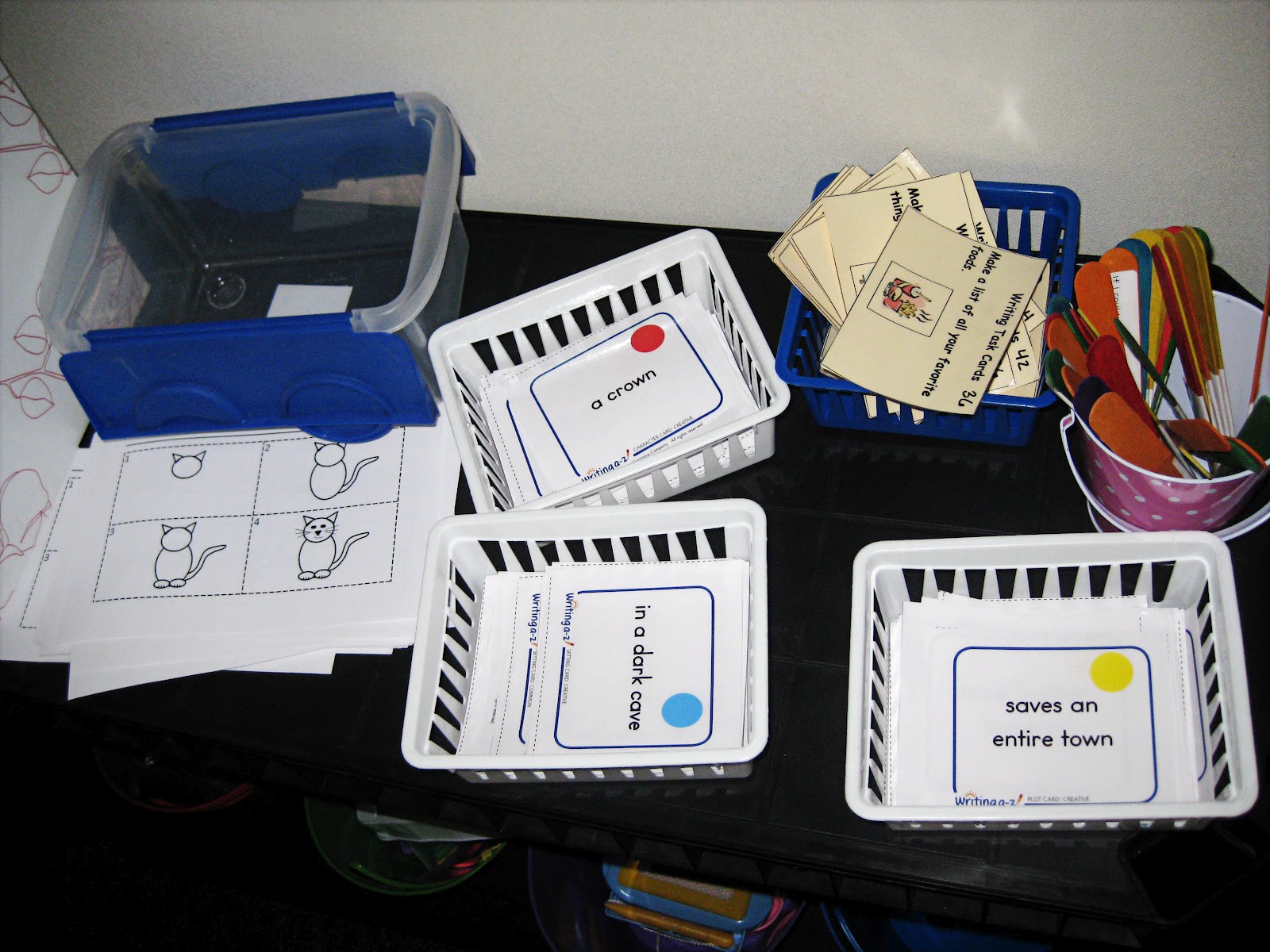
Word Work: Students start by choosing a spelling task card. This gives them some good practice with the weekly spelling words. After they  have completed the card, they are allowed to choose one of the "fun" ways to practice their words. These include: magnetic letters, abc stamps, wikki sticks, magna doodles, and typing words on an old keyboard.


Work on Writing: Students can use this time to write stories about anything they want! If they want help coming up with an idea we have setting cards, character cards, and plot cards. Some of our favorites at this station are the Draw Write Now books, where students learn to draw something new then copy some information about what they have drawn in their neatest handwriting.


Listen to Reading: This is the all time favorite because it involves the computer. Students use a website I have set up that has links to a bunch of different sites with stories they can listen to.

Daily 5 is a huge part of our daily reading instruction. The kids are engaged in reading and writing activities and I have time to meet with each student in a small group setting to work on reading skills at their level. It feels so good to finally be in the routine of Daily 5. So much learning takes place every day during this block of time.

Friday, September 28, 2012

Writer's Workshop: Pre-writing and Drafting

This week we started setting up writer's workshop in our classroom.

I love writer's workshop when it is all set up because the kids are really able to work at their own level and their own pace to create stories, however I always forget how much time it takes to get them used to the routines and set up the procedures!

First I introduced the idea of writer's workshop. Each student got a writer's workshop notebook and we talked about 5 page narratives. The idea here is that they think of something that has happened to them that they could write 5 pages about. We practiced thinking of an idea using our fingers to help us stretch it out to 5 pages, then shared our ideas with our friends.  After sharing, I had each of the kids record their thinking on a brainstorming page in their notebook.  The prewriting step looks something like this:
Next we talked about drafting. We discussed how authors do not just write their ideas one time and then publish, but that there are a lot more steps involved. We talked about how the first step is to get your ideas on paper. They do not have to be perfect, and you might want to add more later, but first you have to get your initial ideas down.  We looked back at our prewriting page and took some time to start drafting the first page of our books.  I told the kids to strive for 3 to 5 sentences on each page, but this can be adapted for kids so that it is on level with their individual writing ability.
We spent a couple days working on drafting our ideas and having some time to catch up before moving to the next step. Not everyone was ready to go on just yet, so we took some time to play catch up.  Students who had finished drafting their first page spent some time writing in their treasure book. Our treasure book is sort of like a diary where students can record their "treasures" or important things that happen to them.

Next week we will be talking about revising to make our writing more exciting and detailed, as well as editing and publishing. After that, students will be able to move at their own pace to complete their stories. Lot's of exciting things ahead! I'll have pictures to post as we begin publishing pages next week.

Post Delay

I have a lot of great things to post this week ... unfortunately, my camera batter died JUST as I was taking pictures for the blog today, and I left the charger at home. So ... a new post about our week will be coming first thing Monday morning! Sorry! Check back soon. Hope everyone has a great weekend! :)

Tuesday, September 25, 2012

www.raz-kids.com

I am SO excited to announce that raz-kids.com is set up and ready for the kids to use!

Students will be expected to read AND take the quiz over 3 books each week to receive credit for homework.  Please note that they must pass the quiz in order to receive credit.

For a better understanding of how the website works, please see the directions below:

1. Log in to the student account
Teacher Name: kmccormackb
Password: your child's student ID number


2. Choose a book to read - When you log in it will show the level I have assigned to your child. Click on the book with the eye to read the book.
Students are expected to READ the book, they will not receive credit for simply listening to the story (the book with the ear).


3. After reading, select the quiz


4. Complete the quiz.
Students must pass the quiz in order to receive credit. If they get a message saying, "good job" then they have passed. If it says "read the book again" they must re-read the story in order to take the quiz again. Remember, they must pass the quiz to receive credit. They can re-read the story as many times as is needed.


5. Check to make sure the quiz is complete.
Looking back at the home screen you can see a green checkmark under the book AND the quiz when both have been completed.


When your child has completed each book on the page, meaning they have read and passed the quiz for every book on that level, please let me know and I can go in and move them up to the next level. Students are welcome to read more than 3 books per week, but they must read at least 3.

Starting today your child will be bringing home a yellow reading folder. This folder should stay inside their backpack at all times when not in use. Inside you will find their first grade reading log. After your child has read a book and completed the quiz they (or you) are to record it on the reading log. You must initial next to each book they read showing that you have checked and know they have done the required work. We have done the first one together in class as an example. I will be checking reading logs each Monday to see their reading from the week before. Please note that I will also be logging on to the website to verify what has been read.

Remember, the more they practice reading, the better readers they will become! As always, if you have any questions please feel free to contact me.

This is such an awesome resource for your children; I am so excited for them to get started using it!